Wednesday, May 28, 2008

Consumerism consumption and waste - Template for development?

As per Natural Resources Defense Council (NRDC), as the world's leading spenders, Americans (5% of world population) use:
  • 20 % of the world's metals,
  • 24 % of the world's energy
  • 25% of the world's fossil fuels.
  • Own twice as many cars,
  • Drive two-and-a-half times as far
  • Use 21 times more plastic than their 1950 counterparts.
  • American ownership of air conditioners also increased from 15 to 64 percent between 1960 and 1987; color TVs from one to 93 percent.


In past few months , increasing food prices have made headlines throughout the world. US president Bush even blamed increasing prosperity of Indian middle class for food shortage. In India itself, Agriculture minister has attributed food crisis to India's changing diet patterns. South Indians are eating more wheat and north Indians are cooking more rice, he said, leading to food crisis. Indian Prime minister, on other hands think that food crisis is due to diversion of arable land from food crops to bio-fuels. In this spate of global blame game, Ban Ki-moon, the UN secretary general said something which should have been so obvious to all, that "world has consumed more than it has produced."

Increasing Consumerism - Who is world's largest consumer? Without doubt it is USA and then Europe. In decade of 1990, 20% of world's population (mostly in USA and west) consumed 80% of world's resources and generated 80% of world pollution. USA which is template for modernity and progress in our times is biggest glutton of all.In modern world which we live in, progress and development is often equated with increasing consumption. I am not economist, but don't most of economic indicators like GDP, PPP etc.. ultimately indicate a society's "capacity to consume"? The more you can consume, the more developed you are. India is developing at rate of 8%/year and China is probably 10%/year. It means demand and consumption is increasing at same rate every year. Same is true for most of other developing and developed countries. Consumerism is at all time high. The whole society seems to be in a big orgy of demand and consumption. Wanting more is fashionable. "thode main hi satisfy kyon ho? " SRK tells us on TV. All pervasive advertisement machinery keeps blaring messages of new wants constantly. Not needs, but wants. You are constantly reminded that you need to buy, you need to consume. Creating collective illusions of needs. It keeps society moving. Like electric current needing potential difference to flow , wants and consumption is what we need to move.


Urabanisation boon or bane? - Economics tell us that Modernity has always come with urbanization. Most of modern countries are hugely urbanized with mega cities. Cities which are are den of consumerism and consumption. Cities which are collection of men living in concreted forts, in their own self obsessed cocoons. Cities demand and consume, very often never being aware of environmental cost at which demands are met. Cities only see finished products, never the process or the waste. Shopping malls sell products you would never need. Be modern, buy tinned food. Buy more plastic. Blinded by gloss, glitz and lights of city , its denizens are on self administered anesthesia, never aware of pain. Cities, for whom, environment is nothing more than artificially created gardens , ponds and caged animals in zoos, all within its perimeter.


Led by USA, more and more countries are adopting a template of development which in long run is going to harm our collective well being. unfettered Growth, voracious consumption and consumerism has already made a serious impact on our environment and there are enough signs of fragile balance of our ecosystem being dented. Annual growth, increased productivity, urbanization, would ultimately lead us where? How long would it continue? Isn't it time to stop for a while and think!Instead of copying a model of development which is undeniably focussed on materialism, isn't it time that we also look into some eastern thoughts which have always preached a simple, balanced lifestyle in harmony with our nature!!

Is it a time to downshift !

Tuesday, May 6, 2008

Annapurna Base Camp Trek


It was on a quirk that I decided to join guys on trek to Everest base camp just when my 2 weeks vacation was coming to an end. Soon I was on flight to Kathmandu where I met Barada and two other guys Arvind and Rohan.


Day -3 (April 22nd ): I Reached Kathmandu in evening and met Barada, Arvind and Rohan; all of whom came on different flights from Delhi. I had arrived 1 hour earlier; I was loitering about in airport compound being continuously pursued by omnipresent hotel/taxi /trek guides and agents. One of the guys struck some interesting conversations, quite predictably about Bollywood, khans, cricket am Prashant Tamang. Once other guys arrived, we went to domestic airport to book flight to Lukla. Lukla is a the starting point for treks in Everest region and can only be reached by small propeller planes. I heard of this place for first time but for next couple of days Lukla was to acquire a hallowed status of a mystical place in our mind. There are around 3 local airlines operating flights to Lukla, but all of them fly before afternoon so we booked the early morning flight on Yeti Airlines for next day.
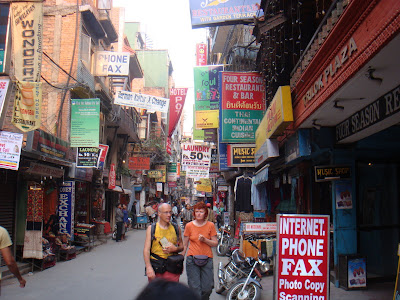

(In Thamel, Kathmanudu's main tourist place)

At night we checked into a hotel in main tourist destination in Kathmandu called Thamel. Like any other tourist hub, Thamel has many budgets hotels, lodges, restaurants and dance bars. After some nice dinner in forms of Thupkas, Barada and chief organizer of Trek Aravind started planning the trek. The problem was that Everest base camps needed minimum of around 13 days with couple of days of height acclimatization thrown in , but we had just 9 days. We decided to push harder on certain sections of route and if required spend just one day for acclimatization. We had a rather lavish dinner at place called oak tree and retired for night.

Day -2 (April 23)
We reached airport to catch the flight to Lukla. As it turned out the weather at Lukla was bad and flights were not able to land there. We waited till noon, when flights were finally cancelled for the day. Since we had squeezed trek into 9 days, it was a bad news for us. Reaching Lukla by road was out of question as it took 2 days of trek to Lukla from its nearest road head. We re-scheduled our flight to Lukla for next day. Since we had time to spend, we walked from airport to top of a hillock and down to famous temple of Pashupatinath. Temple looks quite stunning from inside and is worth a visit. Though it could be cleaner and more inclusive as only Hindus are allowed inside the temple. The ghat near the temple reminds one of Varanasi with burning pyres, final destination of all men ...be kings or paupers.
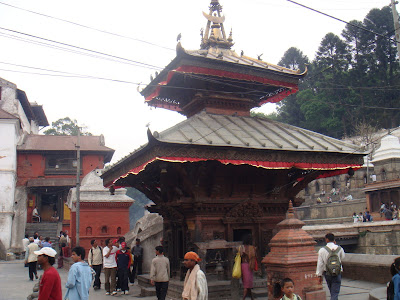

(Pashupatinath from outside)

We spent the night in Thamel again treating ourselves to yet another lavish dinner and drinks with some nice live music. It was second night in Thamel and we were starting to behave like tourist and not trekkers.

Day -1 (April 24): We were back at airport for early morning flight. We were quite apprehensive if flight to Lukla would be possible today and the fears of another day going waste appeared real when flight was delayed by 2 hours. I and Aravind went out of airport to bring some breakfast as food at airport was costly. When we returned after hearty Bread omelet, to our horror, we realized that the flight to Lukla had waited for us and eventually taken off. Barada and Rohan had boarded the flight and we had missed it. That was ominous. We could get our seats adjusted for another flight due in an hour's time. As we were waiting, we came to know that Barada and Rohan had come back as their flight couldn't land at Lukla. It was as near as any of us could get to Lukla. The weather at Lukla had turned bad. To add to our misery we came to know that a flight which took off barely 15 minutes before our flight could land at Lukla. Had we not gone out for breakfast and had the flight not delayed due to us, we could have been on the flight which had landed. Around noon it was declared that flights to Lukla were cancelled for day. Another day wasted. Lukla started to sound like a place where we just couldn't get to. Or was somebody stopping us from reaching there. There was a decision to be made. Either we wait for another day to try reaching Lukla or change our plans or do some other trek. Annapurna trek is what Barada thought we could do in time which we had. But Mystery of Lukla was too overwhelming and we decided to try another day to reach Lukla and do a curtailed trekking in region but not actually doing base camp. We took a taxi to a place called Swambhu, a famous Buddhist shrine on top of hill.
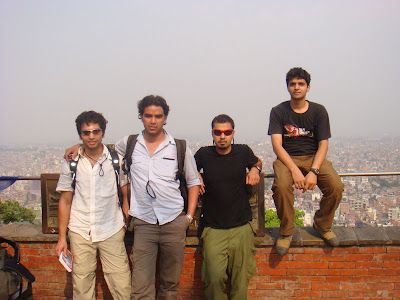
(All of us at Swyambhu Budhist temple)

At night we stayed at heart of Thamel, had beer , got stoned and watched "Touching the void" on Barada's laptop. A fantastic account of two guy's climb of a Peruvian mountain gone horribly wrong. It is a must watch movie as it shows the strength of a man’s will power in surviving against all odds.

Day 1 (April 25) From Kathmandu to -Pokhra - To Ghandrug
Early morning and with an unsaid trepidation we reached airport again and hoped that flights to Lukla would take off today. As the destiny would have it, the flights started getting delayed, a pattern we had got accustomed to in past 2 days. Since we were desperate to do some trekking now and Everest base camp trek was out of question, we changed our plans to fly to Pokhra and do Annapurna base camp (ABC) trek. Pokhra is second largest city in Nepal and is hub for trekkers in Annapurna region. We could finally land in Pokhra at noon on Yeti's jetstream aircraft which took 25 minutes to reach Pokhra from Kathmandu. Barada's ever planning mind (thanks to guide books) had thrown another idea of doing a wilderness trek and camping in the Himal peak instead of doing a tea-house trek to Annapurna Base camp (ABC) . We rushed to tourism office in Pokhra where Barada and Aravind collected information about logistics and cost of doing a camping trek with porters and cook. In an hour we realized that Camping trek would be costlier and also we possibly wouldn't be able to climb a trekker’s peak as it needed some technical climb in certain stretches. By now the desperation to do hit the trail was running high and we registered with TIMS and took taxi to Nayapul. We reached Nayapul at around 2.30 pm. This was to be start of trek at height of 800 mt.
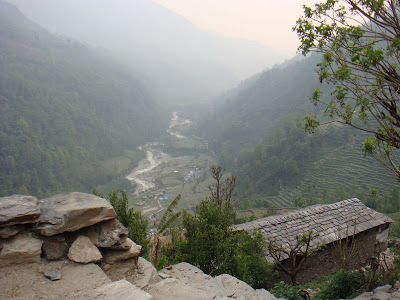


From Nayapul we walked to Birthanti in 20 minutes and another 50 minutes walk took us to Sayali bazar. This was the beginning of hard trek as from Sayali bazar to Kimche village was a steep hike. It was a back breaking climb made more difficult by the fact that we were climbing stony staircase . Half way up the climb and I found myself panting, sweating and cursing. My fitness level was down to zero due to many months of sedentary lifestyle and my body was complaining against sudden burst of hard climb. We finally reached Kimche at 1530 mts., after 2 hrs of Trek. The trail though steep and uphill, provides one of good view of fertile terraced fields and small villages around them. Kimche provide a good view of Modi river valley around Birthanti from where we had climbed 700 mts. After resting for a while in Kimche we decided to push for another hour and reach Ghandrug for night halt. The trail from Kimche to Ghandrug is again uphill and it takes around 1 hrs to reach Ghandrug from Kimche. The night was falling and I had to wait for Rohan who was walking on steady pace. Walking at night with torches on, with a star lit sky and gentle breeze blowing was a fascinating experience. I and Rohan reached Ghandrug around 8 pm and all of us stayed at very first lodge we could find in Ghandrug (2000 mts). IN about 5 hours , we had gained a height of around 1200 mts. After Dinner we had random and sometime heated talks on religion, nature, population and politics and it was to become more or less norm for rest of trek. We had best of sleep at Ghandrug.

Day 2 (April 26): From Ghandrug – to- Chomrong
We woke up pretty early and we had our first look at the distant Snow clad mountains. In this season it is only during mornings that one can have a clear view of mountains. After noon, they are covered by clouds and mist in valleys makes it impossible to see the mountains. From Ghandrug we started trekking at 7 am. An uphill climb of 1.15 hours took us to Komrong Danda at height of 2240 mts. We had possibly one of worst breakfast here. The musli smelt foul and I almost threw up. From Komrong Danda we had to descend by 500 mts to reach Komrong Khola (river or stream). The descend was easy and we reached Khola in 45 min. We had a refreshing bath in the Stream and then started one of steeper uphill trek to Chomrong. Since we hardly had any breakfast and sun was beating hot ,the climb was painful and dehydrating. I and Aravind ran out of water. We should have been carrying minimum of 2 liters of waters on each person as on this trail there is no water midway. Dehydration makes every single step into an agony.
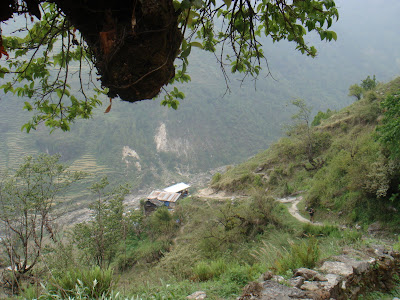
(On way from Ghandrug to Chomrong)
We finally reached Chomrong after 2.15 hours of trek from Khola and drinking lemon water was akin to drinking nectar. Thanks to Komrong Khola our net height gain was almost 0 as Chomrong is at same height as Ghandrug. Chomrong has many lodges and is spread across the hill with some of nicest lodges situated on top of hill. Chomrong is an interesting village as lower Chomrong is around 300 meters below the upper Chomrong and is connected to it through a never ending stone staircase. Barada had read that Chomrong guesthouse prepares delicious pizzas and we started looking for it. The first look of Guesthouse disappointed us as it looked desolated and haunted. Its business seems to have been snatched by more appropriately situated lodges at upper Chomrong, but pizzas which lady of the guesthouse prepared were absolutely fantastic. Best pizzas after Pizza hut and quite unexpected food while on a trek. We stayed for night in excellent view lodge in upper Chomrong. From Chomrong onwards prices of food items were to rise as everything has to be carried by porters and Simple Daal-bhat cost as much as 200 NR.

Day 3 (April 27): From Chomrong -to -Deurali
We woke up early at 5.30 am and were greeted by stunning view of Machhapuchre and Annapurnas.The sight of first rays of rising sun falling over Annapurna and golden hue thus created on them is a stunning visual spectacle. For some it could be a spiritual sight, for others nature at its best and for some others, it can be poetic. If these mountains were to be Gods and trekkers were to be their devotees, then early morning is the time when Gods give their devotees a divine darshan.
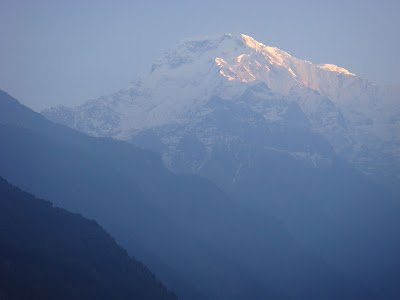
(Sun rise on distant Annapurna seen from Chomrong)

Chomrong is the last village in the region and for rest of trail we wouldn't see any other village after Chomrong. All the lodges on trail beyond Chomrong are owned by villagers (mostly Gurungs) from Chomrong. We started from upper Chomrong at 6.45 am and descended by a stony staircase to Chomrong khola and then did a steep climb up to Sinuwa. Sinuwa is practically at same height as Chomrong. From Sinuwa we passed through a beautiful up-down tree covered trail until the Khuldi ghat. From khuldi ghat we descended further to Bamboo which gets it name from Bamboo forests in vicinity. We reached Bamoo at 10am and it was slightly chilly and a cup of hot ginger milk tea was a welcome relief. From Bamboo we started climb to Dovan and then Himalya. We stopped in Dovan for our lunch By the time we reached Himalya at around 3pm the weather had turned bad and it had started raining. The chill in air was palpable and jackets were out. Even though we had decided to stay at Himalya, Barada wanted to push till Deurali which was at height of 2900 mts and could be better option to spend night and get some acclimatization before climbing up to the base camps. Barada was particularly scared of anyone getting AMS or altitude sickness and wanted to take precautions of not gaining height rapidly. Aravind stayed in Himalaya for night and rest of us pushed to Deurali. The weather by now had gone bad and hails were raining down on us. I particularly enjoyed hike from Himalaya in deteriorating weather and fading light. The vegetations on the trail were becoming sparse and mountains were becoming barren and had snow deposited on them in patches. The whole spectacle around us was mystically beautiful.
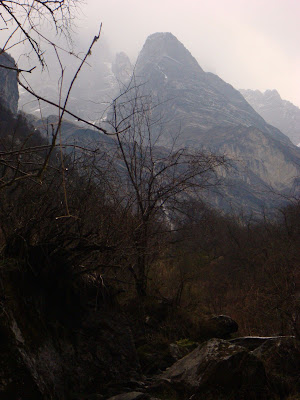
(on way to Deurali)

After the steep hike we reached the Hinku Cave from where we could see Deurali with its 3 lodges. From the Hinku cave to Deurali there is a avalanche and landslide prone area. When we reached Deurali, we got little scare as two of 3 lodges had no rooms. We finally got room in 3rd lodge. It was very cold and snow had started on mountains. We moved to only heated area in the lodge which is like a big dinner room in front of kitchen. A kerosene stove is put under the huge table which is covered by clothes from all four sides. Trekkers sit around the table and can put their hands and feet beneath the cloth to warm themselves. Cost is 70 NR for every person. No wood fires are allowed in Annapurna sanctuary region Two of lodges here have solar powered electricity. In lodge where we stayed there wasn't any electricity. After hot and spicy daal-bhat, we retired to bed in darkness. It was raining outside with thunderstorms, the cold was increasing and seeping into primitive lodge and ambience was prefect to share some ghost stories. We found harder to sleep, possibly due to cold or due to height.


Day 4 (April 28): From Deurali to MBC-ABC
Arvind joined us from Himalaya and we started trek to Machhapuchre Base Camp (MBC). From Deurali, towards MBC, there are quite a few avalanche prone areas and trail first climbs gently through a river bed until it rises steeply over the mountain side towards MBC. 30 mins walk away from Deurali; we found ourselves in middle of river bed surrounded by giant looking mountains with their upper portions covered by snow and lower portions showing stony barren features. When the sun arose, the snow on mountains shone and river valley was filled with warm sun rays. The spectacle was exhilarating. It was quite indescribable in fact.
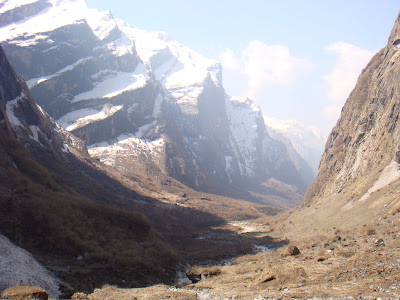

(On trail from Deurali to MBC)

The hike to MBC is tiring but the views keep one going. We reached MBC around lunch time and had our first close up view of majestic Machhapuchre. It looks stunning and when you are that close to a peak, standing right at its base, you realize how hard it must be climbing these giants. They look unreachable. Machhapuchre looks like a huge column of rock and snow with razor thin ridges. How can anybody climb it!! What strength and stamina one must have to climb such peaks. I think one must be mad to climb. Barada wasn’t feeling very well and though he was suffering from some altitude sickness and wanted to rest for day before going to ABC. But after couple of hours rest, we decided to push forward to ABC.
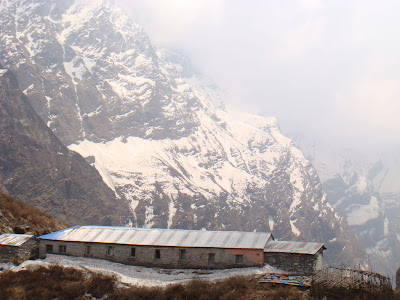
(MBC base camp)

From MBC to ABC trail is pure magic. Vegetation disappears sans some grassy patches on ground. You see snow boulders melting and forming small gurgling water streams. Many such streams from melting snow collectively form rivers downhill.
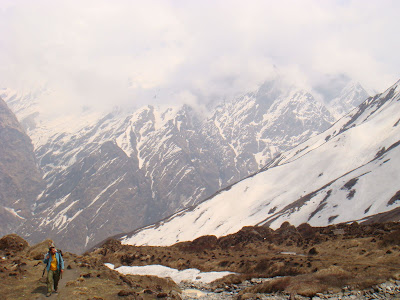
(on way to ABC)

After a hike of just 30 mins or so, we could see the Annapurna Base camp at far side of trail. Finally we were to reach the basecamp. It took us another 30 min of slightly labored walk to reach basecamp and it was an exhilarating feeling. Here we were at 4200 mtrs height surrounded from all sides by huge snow clad Annapurna. From here only trained climbers can scale the peaks. It started snowing soon after we reached the camp and in few minutes the whole area was covered in whiteness.
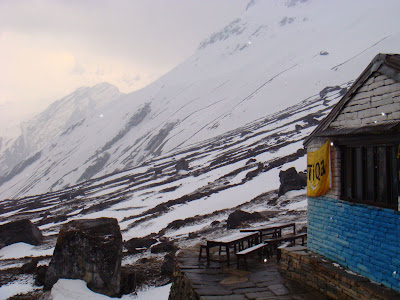

(Annapurna Base Caamp at 4200 mtrs)

We stayed in one of 3 lodges and straightaway made ourselves comfortable in warm dinner room. There were some interesting discussions happening there among a motley group of residents. There was an old Russian who had climbed Everest twice before quitting climbing, a lady trekkers who was hooked to Yoga and natural way of living and an American TV cameraman climber who was in basecamp since a month as part of expedition to climb Annapurna peak. The poster on wall was reminded one that this camp which is destination for trekkers is just a starting point for climbers. Those men who climb these huge peaks of snow. It is here that you realize how hard it really must be to climb. It is here that you see the actual scale and sized of these peaks. Those men who need to be absolutely fit and strong to conquer the peaks. These mountains with their vagaries are ultimate arena for men to test themselves, physically and mentally. These are the mountains where strongest of men can die by just a lose stone falling.
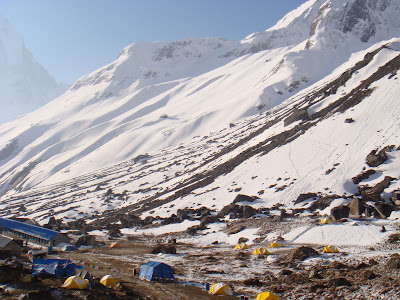

Day 5 (April 29): ABC – to- Dovan
Barada and Arvind had problem sleeping at night and Barada in particular wasn't feeling good and though it was because of altitude sickness. Nonetheless we climbed another 150 mtrs on a ridge overlooking the base camp and views from there were stunning. All around us where the huge snow clad mountains. The Machhapuchre ,Annapurna south, Annapurna 1, Hinchuli and other peaks.
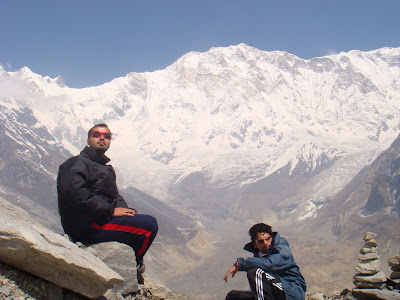

(Arvind and Barada on ridge with Annpurna in background)

The basecamp looked tiny and ephemeral in such surroundings. Around 11 am we started to descend from ABC to MBC, Deurali, Himalya and finally to Dovan. Even though we could have gone till Bamboo, we decided to stay for night in Dovan.
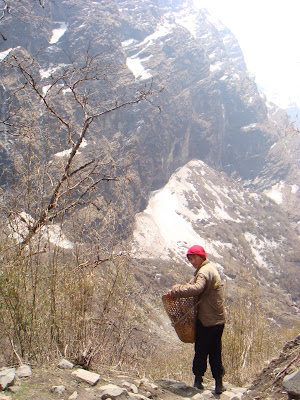

(Way back from MBC to Deurali)

Day 6 (April30) Dovan to Chomrong
We started leisurely from Dovan and descended to Bamboo. From Bamboo we trekked up to steep Khuldi ghatStaircase and rested for one hour on a beautiful fountain. Form Bamboo we trekked back to Sinuwa and then descended to Lower Chomrong and from there familiar thousand stony steps took us to Upper Chomrong and we had pizza again at Chomrong guesthouse. The local wine was nice but only after surviving first few bitter swigs. We stayed at Chomrong at same lodge where we had stayed while trekking to ABC.
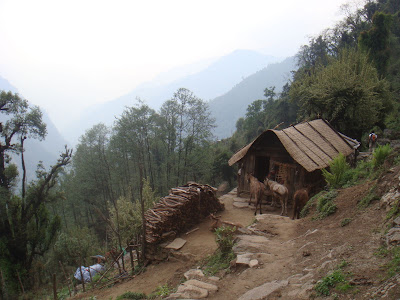

(Trekking down to Chomrong)

Day 7 (May1): Chomrong to- Jhinu – to--Birthanti- Nayapul-Pokhra
Form Chomrong we took a different route and instead of going to Ghandrug, we descended to Jhinu Danda. 15 mins walk away from Jhinu Danda is Jhinu hot springs. Our original plan was to have a rest day somewhere on the trail but we changed plans and decided to end the trek on same day.
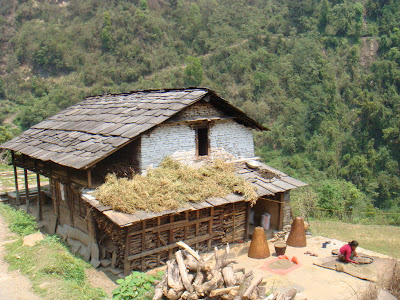

(A Neplai village house on way from Jhinu Danda to New bridge)

So we trekked from Jhinu danda to New bridge and then to Kyumi village where we had beer and lunch. After lunch and towards evening we started trek to Sayali bazar and then down to Birthanti.
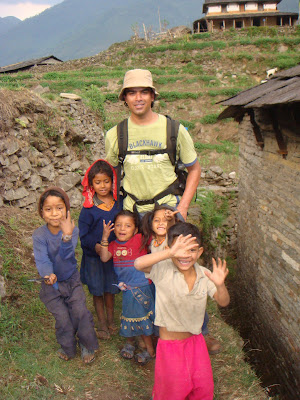

(While going to Birthanti from Kyumi village)

By the time we reached Nayapul, it was dark and late in evening. We saw the buses and taxis and trek was finally over. Taxi driver were haggling for price to take us to Pokhra and buses were overcrowded. On spur of moment we decided to travel on roof of a bus and it was fantastic. With some rum mixed with coke, jokes on Barada man and some songs, the journey through the Pokhra valley in darkness on top of bus roof was the very apt end of a wonderful trek.

Day 8 (May 2): Pokhra –to-Kathmandu
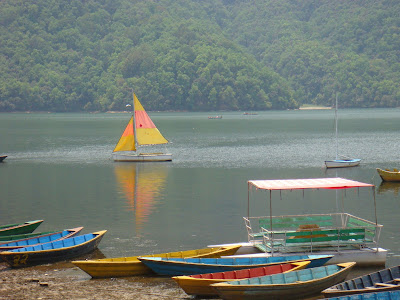


(Pokhra on lake side)

Our return flight from Pokhra to Kathmandu was at 4 pm and as luck would have it flight was cancelled due to heavy rains and bad weather. Couple of Nepalis girls at airport offered to share taxi with us to Kathmandu and soon 7 of us were in a mini van (called Micros by locals ) driving in rains to Kathmandu. It was a fun ride with beer and music and we reached Thamel around 10 pm.

Day 9 (May3) Kathmandu -to-Delhi
We did some shopping in Thamel and took our respective flights to Delhi to return to world of frenetic jobs, noisy traffic and maddening rush. The mountains were left behind. I felt as if a part of me was left behind too and I know that I will return soon. If not to Annapurna then somewhere else in Himalayas. Nepal is trekker’s paradise, people in its hills are simple and friendly and there is no other way to un-clutter yourself than to trek in wilderness away from TV, phones, internet and luxuries of modern consumerist life.

Just like in most estern civilisations, Nepalis treat Annapurna and Macchapchure as Goddess or abodes of Gods. Reason is that these are not ordinary mountains. These moutains sustain human life. Every morning the skies are clear and sun shines brighter on them. The sun heats the snow on peaks and clouds form bringing fresh snow and rain. Snow and glaciers melts to form streams and then rivers which flow to plains giving us water to drink and water to produce grains. If we temper with this cycle, the repurcussions could be imagined.
Friday, March 21, 2008

Tibet Unrest - Ginger and herb people

My very first impression of Tibetans was from my childhood days when every year in winters, a group of "Potlus" as they were called by locals, use to descend in our village bringing with them an assortment of Himalayan herbs and much sought after ginger. In my childhood naïveté, for long time I related potlus with ginger. And that they looked very unlike us, with their squinty eyes, red skin and strange clothes (or robes), coupled with the fact that ginger tasted rather strange and pungent, it created an impression on me that Potlus were somewhat more than us, like some sort of mystical people who knew the source of strangest of herbs which nobody else did.

When I was in my junior school, for first time in my Aunt's Reader's Digest magazine, I read a story of a Tibetan who was jailed by Chinese and kept in a labor camp under extreme conditions. Though then I couldn't understand nuances of political background of story, but moved by the torture and details in story, I could sense that Tibetans must be wronged and persecuted people forcing them to roam like nomads. Moved by the story, I wrote a "letter of mercy" to "Chinese consular in India" and posted it on address which was give at the bottom of story. I never told it to anybody and my instincts warned me that I would never get any reply and one day I might be picked by Chinese secret police and sent to labor camp as well. With Chinese, either you were with them or against them. They were bad people, as I thought then.


People in Exile: But that was long time back. Since then I have read bit of history and traveled little more. Now I know that ginger is not after all mystical and that Tibetans don’t just sell ginger. They also sell sweaters, woolens, shawls and stones in numerous Tibetan markets found in many Indian cities. And when they are not doing any trade to keep the bread coming, they spend life as monks, meditating and rotating prayer wheels. Regardless of what they do for living, they have always appeared to be as mystical as the majestic mountains where they now live (or once lived). Many years ago, when I visited McLeodgunj for first time I was fascinated by little town which looked remotely Indian or even Himachali. It appeared as if an entire people had been uprooted en-mass from some foreign land and planted on top of a Dhauladar Mountain. McLeodgunj is about 45 mins , almost vertically steep road trip away from Dharmsala town in Kangara Valley. In fact during winters and rainy season when the clouds are low, a stranger to valley would not even know that there was a town little further up inhabited by people who were once driven out of their homeland in upper Himalaya by marauding Chinese. That was about 60 years back. Since then Tibetans have nestled almost incognito in lower Himalayan foothills of Kangra, setting up a replica of their Tibetan culture and way of life . A new generation of them has been born there with nothing but just emotional links with people back home in homeland Tibet. Since occupying Tibet in 1950 , it is alleged that Chinese have killed around 1.2 million Tibetans. That is staggering 1200,000 people. Chinese have meddled into Tibetan’s religious affairs, imposed Chinese language and like all conquerors, have taught a new generation of Tibetans a different version of their past and history. China being an autocratic communist country, an iron veil has been put on Tibet so that outer world would never exactly know what Chinese do in Tibet. The recent unrest in Tibet has sparked major violence there and there have been demonstration worldwide. The new generation of Tibetan youth feel that Dalai Lama's path of non-violence struggle against Chinese would not work and they have to become more aggressive or else remnants of their culture in homeland would be wiped out. Chinese quite predictably, have unleashed armed troops in Tibet and shut down all communication channels.

Only Profit matters in Capitalist Economy: One would have thought that there would be widespread international condemnation of this and Unites Nation would take a notice. But everybody is silent. Prakash karat, major leader of Indian Communist Party , said that it is an internal matter of China. Same Prakash karat who can bring parliament to halt if a single Muslim is killed in Gujarat, is silent on what is happening in Tibet. What bloody double standards. This is the time that Tibetans would realize that regardless of Unites Nation, Human right Groups and world is ruled by only one power. Power of Money. Chinese are economic superpower. Americans and Europeans can not offend China. India is in a strange position. It can only offer some spiritual solace but can not afford to spoil relationship with Chinese. In Capitalist society, only economic gains matter. Profits drive people and nations. If Silence on Tibet is the price to pay, it is a small price. Few thousand more Tibetans would be murdered and China would in couple of month's time would showcase its glowing progress and power during Olympics and everything would be forgotten.

And I wonder if some impressions could stay just the same. Impression of a mild, gentle Potlu selling ginger.......

Wednesday, March 19, 2008

Murder On Beach - Goa, is party over?


A young British girl, Scarlett was raped and murdered on a beach in Goa and murkier side of Incredible India bared its face for all to see. It is a face we all know. It lurks behind all the time, behind those shiny visit India tourism posters and beneath glossed up broachers. One would say…..hold on; one swallow does not make a summer. After all, it is just one silly, drugged girl who died in way that she could have died anywhere in world. If you are a foreigner in a strange land you need to be careful where you go at midnight and what company you keep. The girl paid the price for being indiscriminate, gullible and reckless. Horrible that it might sound, it is akin to playing with fire and hoping that you don’t get burnt.


White Skin fascination: That is only one face of story, especially in context of scene of crime, Goa. Goa is a heady mix of pristine beaches, easily available drugs and accommodating locals. But, The undeniable fact is that this incident only adds an embarrassing chapter in already growing book of what foreigner female tourists are facing in India. Many incidents of sexual harassment of foreigners have been reported in past one year. From backwaters in Kerala, to bazaars of Orissa, foreigner women (mostly white skinned) have been bottom-pinched, squeezed, raped and murdered. The reason being given is that Indian men have a thing or two about white skinned ladies. They have this notion that these women are an "easy lay" and that they have lose morals and hence easily beddable. Most of Indian men , and I mean men in bharat, not just those living in shining India have only one source of their knowledge of western culture , and that is through cheap, pirated C-grade porn movies available in most of India's small towns. And all the foreigners they see in those movies are...well quite obviously sexually busy, promiscuous and "lose". All these white foreigners do is, take drugs and have sex. This becomes their only truth about how they perceive westerners, especially women. So it is not hard to fathom what would happen if Incredible India campaign succeeds in bringing in more tourists to India and opens up those places in hinterland for tourism which were till now undiscovered. In a country like India which is prudish and even balks at couples holding hands in public, influx of westerners would open up murkier sides of Indian society. If most Indians equate westerners with sex and drugs, then most Westerners have the notion that India is all about spiritualism and yoga. When twain shall meet, we shall see.

Chor Sipahi: Coming back to Goa, it seems that Goa is up for a massive cleanup, triggered by recent and some past events. Cleanup of Indian kind. It means that Police would now patrol beaches and harass tourists in name of protection. All bars and those gorgeous shacks would be closed before 11. No music would be allowed to play after 11 again and everybody would be asked to switch off their lights and sleep . Partying would be outlawed and you would be watched. You have to explain to Police your motive of roaming on beach if you are caught after 11. You will be asked to cover your bodies so as not to offend Indian culture and you would be asked to keep short hair. Preferably you would only be allowed in Goa with your mommy in tow. The biggest party place in world would be shut down. And all this would be in pretext of cleaning up Goa. Right. But who is going to do it? Police? Same police which is hand in glove with drug runners, pimps and all those who provide the infrastructure for illegal activities. Everybody in India knows that Police is one helluva corrupt institution. All local drug dealers and mafia are let to operate with full knowledge of local police for a hefty sum of weekly money. If it was not true, then why did Goa Police initially try to suppress the truth about Scarlett's murder as a drowning death!! Because they wanted to protect their own!!

There, You can't have the robbers doing cleanup. All it means is that people who want to enjoy a midnight stroll on beach with couple of beers would be put in jail and all those who want to be little nasty would still do that , behind closed doors under protection for little more money than before. In India cleanups are about shoving dirt beneath the bed.


Saturday, February 9, 2008

Raj Thackeray, MNS, Clashes with North Indians- Migratory stories

There are so many ways in which current fiasco of MNS lashing out at migrant North indians in Mumbai and state of Maharahtra can be seen and I believe that fundamentally it reflects conflict between two social groups happening because of pressures of migration and changing demographic profiles . It is a conflict to gain space, political and economical power, even though some of us would so easily blame it on politics and assume that everything is fine afterall if it wasn't for dirty politic played by few. But Politics is only played on faultlines that exist and more so in societies which have more of them, like ours.
Migratory Ways of Indians : In past century, we as human species have made amazing progress and forces of globalisation and ease of travel have led to massive cross-migration of people. Migration from one state to another, from one country to another etc. Not that migration of people is new. Evolution of species tell us how we evloved and how different races were formed and spread across the planet through migration. It is in animal's nature to migrate to places where it can find food and water and where its survival is most likely. Humans have not been any different. But as we know, with advancement in technology and healthcare and capitalist economy becoming more or less default way, migration of humans have been unprecedented in past 200 years. Think about it in our context, just around turn of last century, there were not many "indians" who lived outside of sub-continent and there wasn't a term called NRI (Non resident Indian). Now, indians are found everywhere and are conspicuous largely for their economic success (exept perhaps in Malaysia). They are in large numbers in UK where they are already in third generation. Malaysia has 9% of its population who are ethnic Indians (um..or shall I say ethnic Tamilians!) Indians are third largest ethnic group in Singapore. There is a huge population of indians in middle east (mostly from state of Kerala). In Mauritius , 70% of people are from Indian roots. Huge Indian population was found in east african countries of Kenya, Uganda and Tanzania before some of them were forced out by local governments (remember Adi Amin). Large scale migration of Punjabis to Canada is something we all know of. Such migration is not limited to Indians alone but is also found across other nationalities, like chinese for example. As indians have gone to other countries to settle down, they have naturally also migrated within the country itself. Most of big indian cities have people from all parts of country. Some ethnics groups have been migrating for centuries ;like Gujratis are found everywhere where they could setup businesses.
Conflicts of Migration: Migration of people from one geography to another or rather from one social group to another start creating problem when there is contention for resources or a threat is percieved by host group that thier numbers would be undermined because of large numbers of migrant influx. At that point of time host group is bound to react naturally to protect its identity which could be based on religious, lingustic or racial or sometime combination fo them all. Some time the migration could be such that the migrant is much more powerful, hostile and violent than the host and host would be cleaned up wholesale to make way for migrants. Like it happened in America or Australia to name a few instances. But such events happended in medieval, ancient times. In modern time where nation states are more or less well defined and stable, the migration related conflicts manifest in various ways, mainly in terms of identity clashes. For example, UK after many decades of soft immigration policies now want to stiffen the rules. Xenophobia is rising throughput the world as a natural opposite force of migration and globalisation. Australia has a test for desiring immigrants to test thier "asussiness", . Few people in UK had mooted idea of "cricket based loyality test" to test Asian immigrants loyality. Nothing wrong with that perhaps, while in rome do as the romans do. But can a greek "become" roman if he is merely "doing" what a roman does! How does one become Indian or English! Do only whites of anglo-saxon stock qualify to be an English? Is Sonia Gandhi (a Catholic , Italian married to a Hindu-parsi Indian) an Indian?
Hyphenated-Identities In modern times, individual carries complex set of criss-crossing identities resulting from his/her affliations with diverse social groups. For example, One can be hindu (religion), born off Indian parents (ethnicity), citizen of USA (nationality) making him an American- Hindu- of- Indian origin. In some cases it can be as complex as American-Hindu-Indian-Gujrati-kutchi. Within India itslef , where we have staggering cultural diversity both ethnic and linguistic, the hyphens in one's identity can be mind blowing. Migration of people and cross-pollination (;)) have made question of identities more complex.
Problems with Inter-state Migration in India: So with Indians have been migrating to other parts of world for greener pastures, one would think that migration within the country , from one state to another would be an assumed thing. As an Indian, citizen can live and work anywhere in 26 states, as per constitution. But In India states are mainly formed based on linguistic identities and not purely from Administrative reasons. This means that state has an underlying sub-nationlism, making it a more cohesive unit than a state formed on purely administrative reason would have been. So when a person migrates from one state to another, even if it is neighbouring state, the dynamics of migration and resulting conflicts are more accute. That is the reason we see certain conflicts more in India than anywhere else in world. We are highly tribal and ethnically cohesive people, may be only less than Afgans. Remember riots which happened in Bangalore, city in Karnataka state , between Kandigas (locals) and Tamilians (migrants from neighbouring Tamilnadu)! Kanigads felt than Tamilians were ruling the roost in thier capital city and that they were undermining thier local culture. Tamilains controlled some flourishing business in Bangalore. Bihari migrant labourers are regularly killed by ULFA in Assam and most of Assames feel that bihari "outsiders" comes in large numbers and are threat to thier "culture". There lies the problem, our diversity becomes our bane. We can huddle around language, state, ethnicity, raise the fences and point out that "outsider" who must be kept out if our identity as a group has to be protected. This is potentially true for every state in indian union. The faultlines are there to be exploited by just raising bogey of culture, language being underthreat by influx of outsiders.
Story of migration in Maharashtra: The script being played in Maharashtra is familiar. Initially it was played by Shiv Sena in 1960 when mere 5% of South Indian migrants to Mumbai were occupying most of government jobs , possibly because they were more educated than the locals at that point of time. But large section of Marathi middle class at that time resented this fact (contention of resources) and that led to rise of Shiv Sena. Shiv Sena galvanised people by siting pride in local culture and making "others" from outside standout like sore thumb. Now script is same, but actors are slightly different. Now south Indians are gone (because they are running software companies down south or in US) and government jobs are with locals (and deservingly so) . Now target is low wage earnerers and north indian migrant who does jobs in unorganised sector, like driving 50,000 odd taxies in Mumbai and selling vegetables. The noise is still same, about marathi culture, language and pride beig undermined by Migrants. The same could be true in Tamilnadu or Karnataka or anywhere else in country.
It is free market economic and Identities are many: According to some Marathi historians, Marathis as community or group have always been low on business quotient. Even when Shivaji, the great maratha warrior was winning new territories , he would invite marwari seths to take care of business in new districts (Marwari anyway, is most business savvy community in India). In modern times, it was Parsi and Gujrati migrants who setup big enterprises in Maharastra (specially in Mumbai). Why did they come here? Answer is same ...for why peple migrate. Why indians go to US. Economic benefit, better life. Answer is stil the same why a poor north indian migrates to Mumbai and runs a taxi. Because he earns 4 times more than he could in his native and because there is still demand enough for him to ply his taxi here, meaning that demand is not met by locals. If a mason from North comes and charges less , it is becuase he is being competitive in market and that is resented by locals, just like Indian software programmers would be resented in USA. Migrants are usually hard working as they come to compete and earn and that can be a reason for locals to feel economically threatened. That is the primary reason. But since we are such an emotionaly wired people, we usually raise such issues with lots of emotional spice like culture and language etc. Most of times they are red herrings, specially in context of migration within a country. Why would a north indian migrant not learn marathi , the local language in Maharashtra! That is quite aburd because language is first based on need before it becomes an emotional issue. If migrant from north india can come here and speak with locals and his customers in Hindi, he wouldn't learn Marathi. It is not because he comes here with intent of insulting local language or culture. In fact, most of migrants anywhere are more law abiding since they migrate for economic reasons and dont want to get on wrong side of law or locals. And if one expects a north Indian or south indian or east indian or whatever indian, to become a Marathi or Tamil or Malyali after he/she migrate to respective states,then the question is who is a marathi or tamil or malyali? The one who speaks the language? Would that suffice if a migrant learns the language, eats similar food and dress same? Or would he only become a Marathi-Tamil or marathi-punjabi .........but he would never be a marthi-marathi or tamil-tamil ?
And in all this where does Indian get lost? That is for next post.........

Sunday, January 13, 2008

Bollyline Series - India vs Australia

Let me begin by saying that in my opinion India is perhaps most discriminating country if not racist (depends on what is being racist, I think Mein Kamf by Hitler provides answers to what is true racism ) The incident was perhaps as innocous as it can be in a hard fought cricket match. Harbhajan (Bhajji) had just played a ball and while walking back to creeze, he playfullly (uhem!) hit bowler Bret Lee on his back. What followed would be remembered as an event which changed cricket, perhaps forever. Harbhajan was accused of racially abusing Australian player Symonds who barged into ass-slapping incident as if almost on a cue to execute a well thought of plan by Australians to "mentally dis-integrate" indians just when they had surpassed Australia's first innings total. And it had all begun in Australia's tour to India when Australian team ws given a rather hostile reception by indian crowds and specifically by Harbhajan and kiddish fast bowler Srisanth. They had decided to corner Bhajji and mentally destory him when he visited Australia. This was the chance and they grabbed it both hands. But. Ah that but. But, Australians just did not know that this time around they were not dealing with some "inferiority complex ridden,'" gentle indian contingent who would hang its head low and tolerate any abuse thrown on them. What also did not help was that Australians acted the way they do when they are in danger of being beaten, acting like a pack of wild dogs and not players. India lost the match. Almost 8 umpiring decisions against indians had done the Indians in. And on top of that one of thier players was framed as a racist for calling Andrew Symonds a "monkey". Thugh as we know there was no proof that Bhajji actally did say that and we know that match referee Mike Procter was wrong in concluding that bhajji was a racisit just becuase he trusted two white players more than 1 brown player. Ahem....we know that Mike Procter is one of most racisit people in cricketing world, so him labeling a player from brown subcontinent as racisit and that too wihout any proof was a racipe for disaster. What followed would be remembered forever in history of cricket. BCCI, the Indian body of cricket management threatened to walk out of Australian tour if Bhajji was not cleared of racist tag. BCCI also used its power to, lets say blackmail ICC (world management body of Cricket) into dumping umpire Steve Bucknor from rest of series as he was responsible, as in past, of taking decisions against Indian team. Cricket world was aghast, specially Australians, about this blatant display of power from BCCI. It is worth noticing that BCCI generates almost 70% of cricket revenue worldwide and obviously is biggest power in sport of cricket today. I love that. Let me play devil for now. I love it. So do many Indians. I dont really like BCCI doing what it did, ideally. Which actually amounts to undermining a system. But I know this is hardly an ideal world. Cricket for many decades was run by whites , by England and Australia. System was all but fair.And this continued till Asian cricket picked up steam and Indian economy started growing and started pumping kind of money which whites could ony imagine. E.g Last world cup almost became a commercial dud after all subcontinent teams and specially India crashed out of it in early stages. Money is power. In a captilist world, money is what drives the system. And this time we have it. The Indians. The BCCI. Australians just can not tolerate this. They have not understood that world in past decade has changed. That now its browns who have the money, its browns who now control the sport, commercially. Its browns who now finance high salaries ICC's umpire get. And why should BCCI not retaliate by asking to dump an umpire who is seen blatantly unfair against Indians over so many years in recent past? Why should BCCI not show its fangs? Why should Indians not question an openly racist Match Referee like Mike Procter who without any proof decides to label an Indian player as racisit just becuase two white Asutralian players say so? when these Asutralian Players in question are so fair and just that they decide not to walk off when they are clearly out?? To Hell with spirit of game. Australians have made a system out of abusing their opponents in cricket and they call it "mental disintegration". It bascailly amounts to abusing others..abusing thier families, thier wives and essentially provoking others by calling them dirty names. Now if you provoke a person by calling his wife a slut or calling him a bastard, then you can't run to your mom when the abused party retaliates and call you a monkey or fucking anything in world ..can you? it is like you want to fight with me but you dont want me to whip out a Pistol when you are threatening me with a knife!! What sort of logic is that? But try telling this to Australians and they woudn't understand this. In fact they just dont think that they do any wrong. They are the best players. The best team, the best country, the best culture perhaps. Okey, granted they are best Cricket team. but if they claim they are fair in their behavior, then I can only laugh. And if they blame others of being racisit for calling them monkeys then I would say that injured party here is monkeys not Australians (or Andrew Symonds). What the hell. Australia is the country, which has not history beyond few centuries in past, leave alone their culture. We now where they came from and how and what they did to people land who hosted them (a lost generation). And we also know what they mean when they say that they pay "fair but hard". I can only pity them. I know. Our crcicket team is bunch of weakers. They couldnt last bloody 3 overs. But for now, I am happy that BCCI has bared its fangs and shown beer guzzelrs who is ruling. And Isn't is just the beginning? And in a larger context of "Shining India" story it is just another example of India taking on the world. For now, and perhaps for a long time to come, It is not Pakistan but Australia who would be Indian cricket's most hated enemy. And that symbolically also tells us how India has moved ahead onto a larger stage of world than being limited to being compared to its unworthy neighbour.

Mate, Monkeys arwe venerated in India as gods and so are just about any other animals you can thought of.

Friday, June 29, 2007

Gone for a while

Will be offline for a while or for a long time. Just want to have more immediate experience.

Looking Inside

Thursday, June 21, 2007

Presidential election in Democracy

What does president of India do? He is a figure head with minimal legislative powers, mostly representing spirit of country and acting as conscious keeper of constitution. We might argue that post of president is a legacy we borrowed from our system of democracy which was based on British system and is a redundant post. Who is this Pratibha Patil, the new presidential nominee of congress for president election! Just around till two weeks back not many in this country would have known who she is! Then why is she president candidate? Because she was hand picked by Sonia Gandhi! What are her qualifications! That she was some ex whatever minister and she was quite and calm and uncontroversial! Or is it that she is a woman and hence if elected, which she would be because she is nominated by party in power, would become first female president of India. As if it was really important to prove gender equality and female empowerment by electing a female president. Such symbolism means nothing. We are anyway a country replete with symbolism. So why would we need another one? I am not trying to say that she is not capable or eligible for post of president! . But if she is; then lots of else are also. Why not any ex minister! Why not any other woman!

The point is that nobody in this country would knew her just 2 weeks back and suddenly she is in limelight and has already put her foot in her mouth by commenting about veil and how it was enforced on women during Muslim rule. So she needs to get her history and PR right, and the moment there was limelight on her, she came out with controversial statement also! Why not choose Abdul Kalam for another term! He is popular, one of greatest Indians, is apolitical, is tremendoulsy knowledgeable and importantly has by and far topped all the media polls for popular choice as president! If we are a democracy then why not give second term to a highly popular president even if it is just for namesake! Why to elect a little known person just because she happens to be a pliable woman close to a certain family.

Tuesday, June 19, 2007

Rushdie, Knights and Intolerance

There is lots of humors in world. Salmaan Rushdie , the controversial writer who wrote Satanic Verses and then spent entire decade running and hiding from people who perhaps never read his book but wanted to chop off his head, was recently awarded knighthood by UK. That is funny. I mean, I thought Knights belong to bygone era. I just can not imagine Salmaan Rushdie as a mounted combatant, carrying sword and galloping on a horse with a nice damsel for a company. Stereotypes.

I think these days everybody is in good humor, or how else would you respond to this news that "Pakistan parliament protests Knighthood honors to Rushdie". Parliament in Pakistan!! Hello! I thought Pakistan had military rule since last few years so what does its parliament do, apart from arguing and dreaming over Kashmir endlessly! Another funny reaction is from Iran which accused British leaders of Islam-o- phobia , which though is quite understandable, given the recent hostility between two countries.

Now call it clash of civilizations or whatever and enough has been said and written on it. But what these guys protesting over Rushdie do not perhaps understand that countries like UK are free, tolerant , liberal societies where an individual enjoys rights and freedom of speech and opportunities which most of people in countries like Pakistan, Iran etc. can only dream of. These countries also dont persecute people based on religion as much as other supposedly slef-righteous countries do. I will give an example from my own experience. Couple of years back when I was working in UK, on one of lazy Sunday afternoons I happened to be in city square in Birmingham where about 3 dozens Muslim (quite visible form skull caps and beards) protestors were gathered to protest against I don’t remember exactly what. There were half a dozen Policemen watching the whole proceeding from distance and a thin crowd of curious onlookers mostly made up of weekend shoppers. One of the protestors, on stage was lecturing and bemoaning the persecution of Muslims in Britain, intolerance of British society and how they were made to suffer in UK. I found it funny since here was a muslim man who was living in UK and was free to stand on city square and criticize the country and people which had given him home when he had probably come looking for job and better life. Is this persecution! Is this intolerance! Nobody hurled a stone at him, nobody stopped him and nobody from white crowd jeered him, the same people he was trying to accuse in his talk. I felt like asking him, if his own country which I presumed from his talk was Pakistan, would even let anybody so openly stand in city square and do someting like him without risking injury or jail! If you are in Iran perhaps and happen to be let’s say Christian and you gather on Tehran’s city square and do the same thing, you would perhaps be butchered! If you are a hindu in Iran , would you be allowed to build temples and follow your religion without fear! Now how much is that for tolerance and accusing others of phobias and intolerence .

Monday, June 18, 2007

Web 2.0 and Grandma

Just been involved in IT a bit more than I usually. A usual topic of discussion these days among guys who keep abreast with technology is about Web2.0. People keep asking what it means to us and how our company (I don’t mean place where I work, but generally) can use Web 2.0. Web2.0 could be a larger discussion and simply put it is another milestone in Internet's evolution from a simple network of interlinked pages to whatever it is going to become in future, but what lots of us fail to understand, specially in IT companies, is that web 2.0 is also about a mind shift. It is democratization of information, more participation; everybody is welcome kind of thing. Ok may be not. That’s a separate discussion. But, essentially it is about tools which have reduced entry level barriers to internet and IT for those who know or care nothing about PHP, Java etc. I mean take blogging for example. Even grandma can blog and have her recipes shared on internet. How easy has it become really. And imagine what it can do (not blogging but open approach) industries which rely so heavily on knowledge and know hows of its people. Call centers, IT companies to name a few.

But try telling this to traditional thinking, control freaks at work who talk about knowledge management and take the management part bit more seriously than the knowledge they seek to manage. They would not understand. They seek to control knowledge as this is what gives them power they can wield. What does Web 2.0 means for enterprises where bosses communicate to employees through emails which are written by them and sent to their secretaries for forward to employees, as if they never heard of thing call mailing list!! Can any employee be open to approach his boss who communicates to him through email sent by his/her secretary! And anyway, email is so heavily misused. I mean how many times have you got important documents, newer versions of processes, templates, resumes, umpteen numbers of communication delivered through email! And then you would have scoured through your mail box to find them when needed. I have seen departments launching portals with fan fare, portals where all you find is some crap about what department does, as if nobody working there knew what it did anyway! And then there would be flurry of congratulation mails and some people would be happy and portal would be forgotten. It is ironical but most of IT companies which earn their bread and butter by claiming to have skills in solving their clients’s information management problems, can not manage their own information and knowledge which keeps getting scattered all around employee mail boxes and lost soon enough in cyber black hole. IT companies are slowest when it comes to adopting the technology they preach their customers. One can argue that it is about putting heads to job and for internal work that is a problem, problem of who is going to foot the bill. But I think it is more about poor leadership and lack of understanding that little investment in their own IT systems can give them huge benefits, even impacting their bottom line. And then it is also about making fewer managers and lessening barrier to information. How many companies have simple system where they can go and check what were new projects in what domain in what department when they were on bench and looking for suitable projects. This simple information would be locked in couple of guys heads and you need to chase them to get these million dollar information. It is about controlling information. That’s what power is about and unless that changes Web 2.0 is a nice topic for discussion among bunch of people who like to be addressed as architects and not engineers as if being engineer was a lesser thing to do.

But before we understand that or change ourselves, we need to get used to emails a bit more. I mean if you can type your email then surely you know how to send it too unless it makes you feel powerful and important. Web 2.0 till then can wait and grandmas can share some recipes even as some people in bar camps ponder over what humanity would become because of blogging. But that’s for later.

These are my personal views which I dreamt last night and have no connection with my profession.

Friday, June 15, 2007

Tickets and Holes

Have not written anything of lately. Been baking some cake and cookies and having some boring routine.....

9.30 am : Reached Office. Have to login in to internal knowledge system to put up project information for team members. Had put up request for creation of user id 2 days back (yeah, we still do that and it takes 2 days) and hoped that I will be able to login but I couldn't. I raised a trouble ticket, ticket 1.

9.45am: Have to fill my timesheets for week today. Have to log timesheets in 3 different systems. Same information , three sytems, three different passwords, 10 differnt codes, for three different set of people to look. I do it on two systems successfully and feel good.

10 am: Third system is new, I am using it for first time. Atleast it lets me login. System is just not accepting the inputs and pages are all garbled up. I fiddle with it for sometime and realise that it uses javascript which just wouldn't run on firefox browser. Cyber pollution anyone!

10.30am: Enough of seeing JS and HTML errors, I quit firefox , open my IE browser and remember that IE wasn't working for quite few days and anyway I dont like IE that much. Employer's policy is to use IE. I log trouble ticket to get IE fixed on my system. Ticket 2.

10:45 am: I see my mails and find 2 mails from guys claiming to report to me and asking me to create thier goal records. I login in to another system with another password and find out that I dont see them in my records in that system. I am confused. I call them. They tell me I am thier supervisor as per another system. I check that another system and find out that it is indeed true. I am confused. Which system is right. I raise another trouble ticket. Ticket 3.

11.30 am: I get mail for trouble ticket 1, saying it is fixed. I check it, it doesn't work. I call up the guy. He checks something and tells me there is perhaps problem updating database. I reopen ticket 1.

11.45 am: I have to download this software I want to evaluate, from internet. Site is blocked. I am confused. It is a tech site run by a freelancer!! His name is adam so his site is adambalahblah.something. Adam==eve==Sex. Proxy doesn't like it (!!). I raise ticket to download the software. Ticket 4.

12:30 pm: I am irritated. I need a break.

1.30 pm: I check my mail. I have a mail. Ticket 3 is fixed. There is system A and there is System B. System A has same information , system B has same information. Both exist for two differrent departments. You update A, B has to be updated You update B, A has to be updated . Manually. Sometime we miss it. So we create tickets.

2-6pm: Meetings, meetings and calls. 2 min work takes 30 min. Tickets open and tickets close.

6:30pm: Time to go home. Big traffic jam. BMC is digging road to replace underground wires. This is for 10th time in as many months. Same road, different holes. 20 people working on it for weeks. 10 dig with primitive instruments, 5 carry the soil and dump and and rest 5, well they rest.

Have human resources. Lots of them. Spill over everywhere. Make use of them. In creating tickets, in solving them, digging holes and filling them. Fine with me. Spare me some tickets and holes and let me bake some cake. Eat it and keep it too. But it is my choice. So I will come again tomorrow for more tickets and more ..........

Wednesday, June 6, 2007

Caste wars - Gujjars burn public property

Recently around 140 countries agreed to make October 2 as international day of non violence to respect Mahatma Gandhi and his philosophy of non violence. In his own home country though, what we have witnessed last week was not only shameful shameful but also made a mockery of rule of law. Gujjars, who are some sort of caste and tribe in Rajasthan, went on massive protestation throughout the north India to demand them being categorized as Schedule Tribe (ST), so that they could get benefits of reservation in education and jobs meant for other lower castes listed as SC and ST. If we ignore violence which these men resorted to, I find it funny that there are people who so vehemently want to be categorized as lower caste tribe. Talk about upward mobility here! I am always perplexed by staggering number of castes and sub castes we have and how we keep sticking to them instead of making such archaic ideas redundant. I don’t know if Gujjars deserve to be listed as ST and given benefits of reservation or not, but what really stands out from the whole episode is the utmost disregard these men showed to public property and other citizens who had nothing to do with Gujjars getting into ST list. Crowds of these men went on rampage, blocking highways for days, burning, looting and destroying public property at will. Many of high valued machinery used for National Highway project in Rajasthan was destroyed and whole work on highway construction was brought to halt. What were these people trying to say? That they don't need highways and buses! Didn't they know that by doing all this they were only harming other innocent people caught in cross fire and this way they would have lost any goodwill they would have had! Even Capital Delhi was untouched by the violence. In one of the visuals shown on news, a dozen protestors were seen burning buses in full view of camera. After burning the bus, they unabashedly, stared at TV cameras and laughed and smiled as if they had just done a great act of bravery. Anybody who follows news regularly would see a pattern of behavior here. Group of people resort to violence mostly without any provocation, and in their minds protest is equated with burning and looting, and unless highways are blocked, trains are stopped and cities are brought to standstill, protest is not said to be effective. Then they openly peek into TV cameras and celebrate as if they are heroes. You don’t need to be expert to tell that such people who indulge in such activities understand nothing about what they are demanding and are mostly people who are bored in life. It is such a shame that nothing is done to punish these people. The rule of law can not be relaxed because a group of men, a caste felt that they were denied something legitimate and were angry with the system which they think is hijacked by another caste of Meenas. It is not an excuse to cause extensive damage to public property and cause nuisance and inconvenience to others. There are other means of protests and raising your demand, burning building and buses are not any of them. I think, it is high time that an example is set and police should catch all those who were captured in TV burning buses and blocking highways and persecute them. Come on, people, you are not fighting some foreign regime here.

How stupid it all sounds. Gujjars were demanding listing in ST category and Meenas (another one of 10 million castes) who are already in ST bracket started opposing it fearing that thier benefits from reservation would be diluted if Gujjars were also to be listed as ST and we almost had a caste war between Gujjars and Meenas. What will be next! Would it start a race where someone would be trying to prove that they are more backward than the others and others would fight back saying that only they are backward! So utterly ridiculous. A social problem, instead of being socially mended has been hijacked by politicians and lines of divisions are being further accentuated. May be it is not right to blame just the politicians alone as the fact is that we don’t have leaders in this country anymore, we just have men who are doing business of politics, otherwise so called leaders of Gujjars would have known that they can only lead their community into next century by making it aware of education and opportunities beyond few government jobs which they want to get through reservations. But regardless, all those who indulged in senseless violence and destroyed public property should be caught and put in jails.